
Research
-

With this device, the team can collect the patient’s own tissue, sort and culture the cells and then place them back into the patient all in one day, said Lauderdale. It can take weeks to perform this task using conventional methods…
Posted in: Research -

The newly created public-private partnership, called the National Institute for Innovation of Manufacturing Biopharmaceuticals, or NIIMBL, will focus its efforts on driving down the cost and risks associated with manufacturing advanced cell and gene therapies for biopharmaceutical production.
Posted in: Research -
 Posted in: Research
 -

“Now we can look quickly, at greater numbers, to take a closer look at a multitude of different strains and possibly identify the critical window of susceptibility for Zika virus-induced birth defects,” said Brindley. “With this approach, we can continue to further design and test therapeutic efficacy.”
Posted in: Research -

“I had the opportunity to go to a couple of patient meetings and be able to interact with some of the people that had the disease,” said Mortensen. “I got to see how they were dealing with the challenges and even to meet some of the children.”
Posted in: Research -

When they learned about a super-resolution microscope custom-made by researchers with the College of Engineering(who were located next door), the RBC provided a natural way to connect and develop pilot experiments to look at DNA sequences in a 3D structure. It’s valuable access to a lot of people who are doing some very interesting things, and…
Posted in: Research -

“What sets this cell-based production system apart from the others is that it’s quick, easy to use and versatile in that it can be applied to multiple vaccine types; for example, Newcastle and, potentially, influenza vaccines, and both animal and human vaccines,” said Stice, director of the RBC…
Posted in: Research -
 Posted in: Research
 -
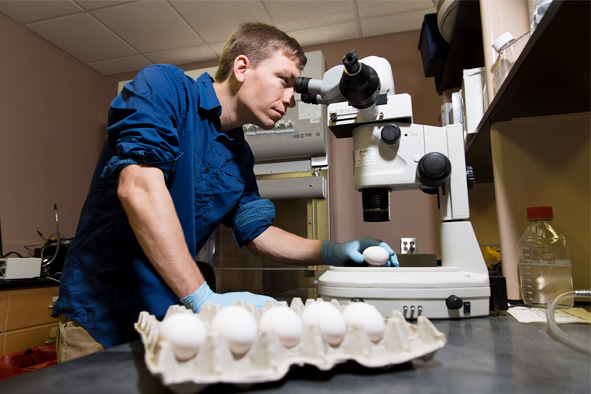
“We went to great pains to prove and demonstrate that our labeling method does not harm the stem cells,” said Goodfellow, who started as an undergraduate in Stice’s lab while majoring in animal and dairy science in the UGA College of Agricultural and Environmental Sciences. “If we…..
Posted in: Research -
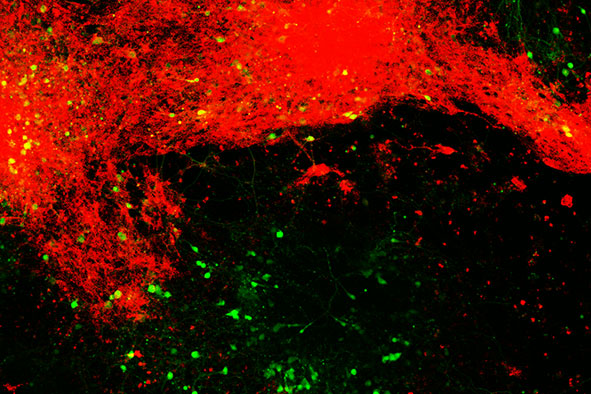
“UGA already had outstanding faculty members and researchers working on stem cells,” Stice said. “What was needed was a new, internal, collaborative coalition (at the university) that could promote spontaneous interactions between researchers who might not have been natural collaborators in the past.”…
Posted in: Research